

A homebuyer can enter the correct figures into a calculator and still walk away with a misleading answer. The problem is often not the formula; it is the assumptions behind the numbers. A reliable dti ratio for mortgage estimate should reflect documented income, required monthly debts, and a realistic future housing payment. When one of those inputs is incomplete, the percentage may look better or worse than the figure a lender eventually uses. The following seven mistakes explain why online estimates can disagree and how to build a more useful home-loan stress test.
Mistake 1: Using Take-Home Pay Instead of Gross Monthly Income
The basic debt to income ratio compares required monthly debt payments with gross monthly income, meaning income before taxes and payroll deductions. Using take-home pay produces a different percentage and makes it difficult to compare your estimate with a lender calculation. Someone who says, “I want to calculate my debt to income ratio,” should begin with monthly gross income shown on pay records or other acceptable documentation, not the amount deposited into a checking account.
Variable income requires extra care. Overtime, commissions, bonuses, seasonal income, and self-employment earnings may not be counted exactly as they appear in a strong month. A personal worksheet can include those earnings for budgeting, but a lender may average or document them differently. This is one reason a self-calculated debt to income ratio for home loan estimate should be treated as preparation rather than an approval decision.
Mistake 2: Entering Loan Balances Instead of Required Monthly Payments.
DTI generally uses recurring monthly obligations, not the full amount owed. A $20,000 auto balance does not go into the formula as $20,000; the required monthly payment does. The same principle usually applies to credit cards, student loans, personal loans, leases, and other installment debt. Confusing balances with payments can make a mortgage debt to income ratio look impossibly high.
The reverse mistake is leaving out a payment because the balance feels small or because the debt will be paid off “soon.” Until the obligation is actually resolved and documented, it may still matter. Build a list from current statements and credit reports rather than memory. That produces a cleaner debt ratio for mortgage analysis and makes it easier to explain any difference between your estimate and the lender’s figure.
Mistake 3: Estimating Only Principal and Interest for the New Home
A proposed housing payment is usually more than principal and interest. Property taxes, homeowners insurance, mortgage insurance, and homeowners association dues can materially change the total. Buyers who use only the advertised loan payment may underestimate their debt to income ratio for mortgage and their debt to income ratio for buying a house.
Before you calculate debt to income ratio for mortgage planning, estimate the full monthly housing obligation. Test more than one property-tax level and insurance estimate because two similarly priced homes can produce different monthly costs. The goal is not to predict the exact final payment down to the dollar. It is to avoid building a home search around an unrealistically low housing number.
Mistake 4: Treating Every Online Calculator as the Same Tool
Search results use many labels for similar tools: dti calculator, debt to income calculator, mortgage debt to income ratio calculator, dti mortgage calculator, debt to income ratio mortgage calculator, and debt to income mortgage calculator. The names overlap, but the input fields do not always work the same way. One tool may ask for a total housing payment, another may build the payment from separate fields, and another may exclude obligations you assumed were included.
A debt to income ratio to buy a house calculator is most useful when the user can see every input and change one assumption at a time. A dti ratio calculator should help compare scenarios, not merely display one percentage. Run the same verified figures through two tools. If the results differ, inspect the housing, income, and debt fields before assuming one calculator is wrong.
For more detail, read Mortgage Research’s The Real Story on Debt-to-Income Ratios.
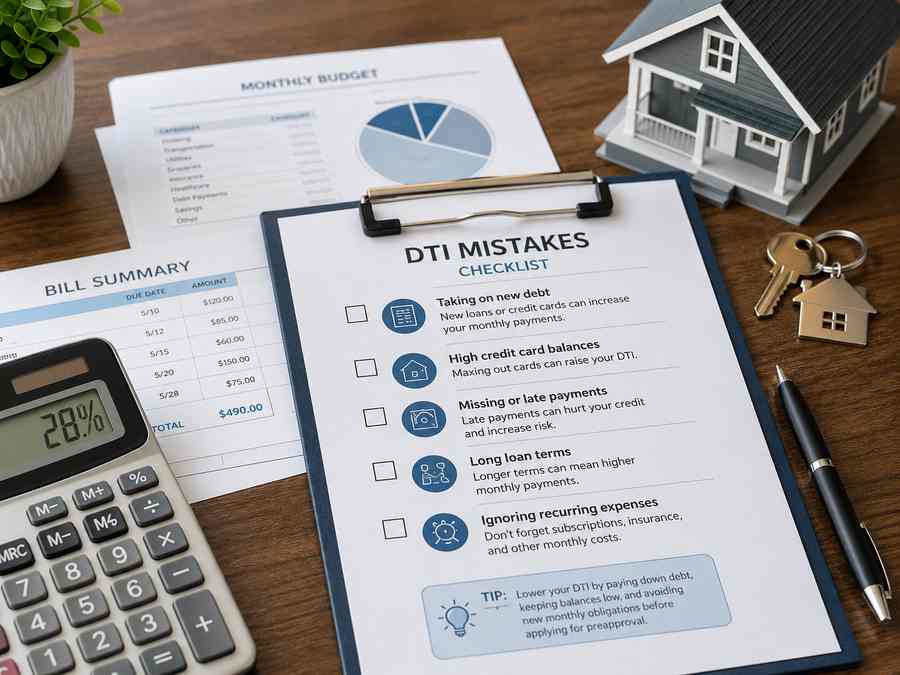
Mistake 5: Confusing Front-End DTI With Total DTI
The front end debt to income ratio compares the proposed housing expense with gross monthly income. Total or back-end DTI adds other required monthly debts. A buyer can have a reasonable housing-only percentage and still have a high total ratio because of auto loans, student loans, credit cards, or support obligations. Another buyer may have little non-housing debt but choose a house payment that consumes too much of the monthly budget.
When an article refers to debt to income for mortgage, confirm which ratio it means. A general statement about a good dti ratio is incomplete without context because loan programs, underwriting methods, and the rest of the application can matter. Use both housing-only and total figures to understand where the pressure comes from instead of chasing a single universal target.
For a consumer explanation, read the Consumer Financial Protection Bureau’s What is a debt-to-income ratio?
Mistake 6: Assuming FHA Automatically Solves a High DTI
Consumers often search for an fha debt to income ratio because they have heard that FHA-insured loans can offer flexibility. That does not mean every higher ratio is automatically acceptable. A debt to income ratio for fha loan estimate still depends on how income and debts are documented, the complete application, and the lender’s process.
The same caution applies to a debt to income ratio calculator fha result. The tool can perform arithmetic, but it cannot decide whether a particular income source is usable or how a specific obligation will be treated. Use the percentage to organize questions for a mortgage professional rather than interpreting it as a guarantee.
For another explanation, read Rocket Mortgage’s Debt-to-Income Ratio Explained.
Mistake 7: Optimizing for Approval Instead of Monthly Resilience
A lender calculation measures required debt obligations, but it does not include every expense that affects real life. Childcare, groceries, utilities, health care, transportation, home maintenance, travel, and savings goals may not appear in DTI. A buyer can satisfy a debt to income ratio for mortgage approval and still feel financially trapped after closing.
Use the dti ratio as one boundary, then build a second household budget using take-home pay and all recurring expenses. This second budget is not the lender’s formula; it is the affordability test that protects the rest of your life. The best home price is not necessarily the highest amount supported by an automated approval.
A Ten-Minute DTI Stress Test Before Preapproval
Start with a baseline using documented gross income, current required payments, and a complete estimated housing payment. Next, run three small shocks: increase the housing estimate by 10%, reduce usable income by 10%, and add one realistic monthly cost such as an association fee or higher insurance quote. The exercise shows whether the plan has breathing room or depends on every assumption going perfectly.
Then test one improvement. Remove a debt payment that could realistically be eliminated, lower the target purchase price, or increase the down payment without draining emergency savings. Recalculate the percentage after each change. This approach turns a calculator into a decision model and provides a more practical view of the debt to income ratio for mortgage than a single best-case result.
Finally, save the worksheet and bring it to the preapproval conversation. Ask which income was counted, which debts were included, and whether the lender’s housing estimate differs from yours. That comparison makes the debt to income ratio for home loan process easier to understand and helps identify the exact assumption that changed the number.

Use DTI to Find Errors Before They Become Loan Problems
DTI is simple arithmetic built on inputs that are not always simple. Using gross income, verified monthly payments, a complete housing estimate, and clearly labeled calculator fields will prevent most errors. Comparing front-end and total ratios, treating FHA results as estimates, and stress-testing the payment creates a more useful picture than searching for one perfect cutoff.
A careful estimate will not replace underwriting, but it can improve the questions you ask and the homes you consider. The strongest plan is one that remains workable when taxes, insurance, debt payments, or income are slightly different from the first estimate. That is how DTI becomes a homebuying tool rather than a last-minute surprise.