

The dream of homeownership in the Beehive State is an exciting journey, but navigating today’s
market can feel like chasing a moving target. With the housing market mortgage rates
experiencing constant shifts, local buyers often find themselves wondering exactly what it takes
to transition from casually browsing homes online to holding the keys to a new property. When
you first begin your search, it is completely natural to look at a national index or play around
with a basic web tool to see what your monthly payment might look like. However, there is a
massive structural difference between an unverified web estimate and a firm, underwritten file. If
you want to successfully secure a property in Utah’s competitive real estate landscape, you need
a concrete, step-by-step strategy to move from digital speculation to true transactional readiness.
Current Mortgage Rates and the Limitations of Online
Estimators
When analyzing current mortgage rates, remember that the lowest advertised rate online isn’t
automatically the rate you will receive. For most buyers, the journey begins with an online
mortgage calculator. You type in a home price, plug in an estimated down payment, and look at
the resulting number. While these tools are fantastic for a baseline visual, they operate in a
vacuum. They rarely account for localized property taxes, exact home insurance premiums, or
the specific pricing adjustments that lenders apply based on individual credit profiles. To stay
grounded on what benchmark products look like systematically, buyers can review the market
data updated weekly by Freddie Mac’s Primary Mortgage Market Survey. Relying solely on a
generic tool can lead to severe sticker shock later on. For instance, if you are looking at a
higher-end market and calculating jumbo mortgage rates, a minor fluctuation in your final
qualified tier can swing your monthly obligation by hundreds of dollars. To protect your budget,
you need a tool that digs deeper into your actual financial health. Utilizing a mortgage
prequalification calculator is a much smarter starting point, as it begins to look at your actual
financial baseline rather than just hypothetical numbers.
Mortgage Pre-Approval Requirements: DTI, Income, and
Assets
Securing a formal mortgage pre approval requires a deep dive into your personal financial
history. Before you ever speak with a loan officer, you need to understand the two heavyweights
of lending criteria: your assets and your debts. First, let’s look at the cash required to close.
Determining your down payment for house purchases isn’t just about hitting a magical 20%
mark. While 20% down avoids private mortgage insurance (PMI), many federal and state loan
programs allow you to buy a home with as little as 3% to 3.5% down. Second, lenders will
scrutinize how much of your gross monthly income is already spoken for by existing liabilities.
Your debt to income ratio for mortgage qualification—often referred to as your DTI—is
arguably the most critical metric on your application. Lenders cross-reference these percentages
through automated underwriting systems to see how safely you can handle a new monthly
payment. Understanding this formula is the exact key to figuring out what am i qualified for
mortgage options across the state. When you formally request a home loan pre approval or
house loan pre approval, you are essentially completing the heavy lifting of the mortgage
application upfront. Having an official letter in hand proves to real estate agents and sellers that
you have the confirmed financial backing to close the deal. In a tight real estate market, a
verified house loan pre approval letter is often the exact tie-breaker that causes a seller to
choose your offer over a competitor’s.
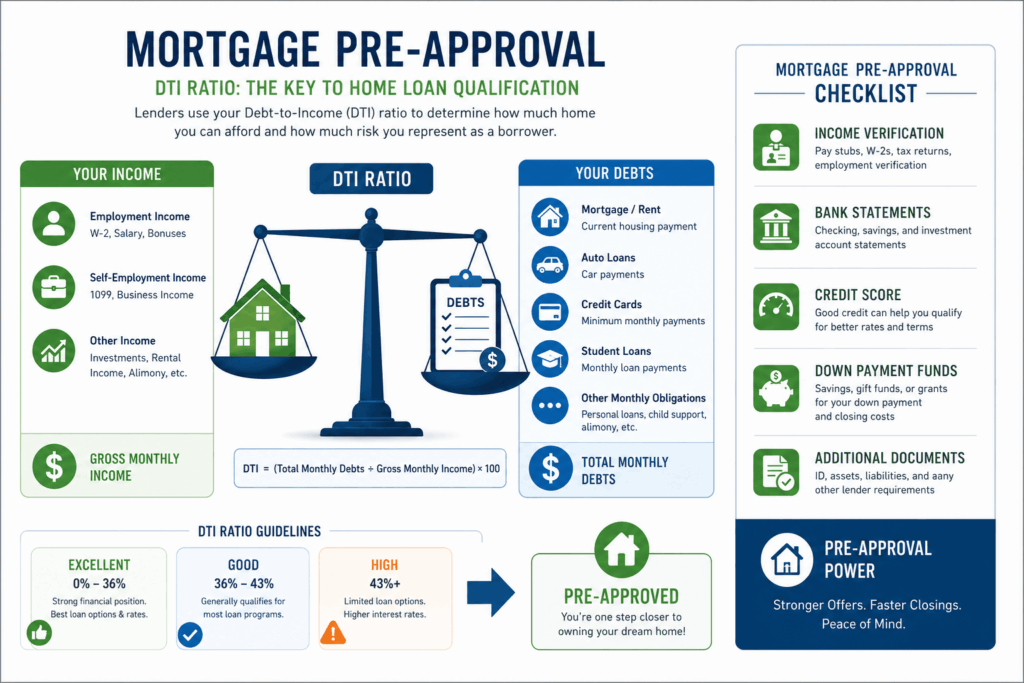
Mortgage pre-approval infographic showing debt-to-income ratio calculation, income
verification, credit score requirements, bank statements, and down payment savings
Activating Specialized and Local Loan Programs
One of the biggest content gaps on nationwide financial sites is the failure to highlight localized
assistance. Utah buyers have access to incredible lending vehicles designed to make
homeownership highly accessible. If you have never owned a home before, or haven’t owned one
in the past three years, you should aggressively explore specific first time home buyer
programs. These can include down payment assistance grants and zero-interest second
mortgages that cover your upfront transactional costs. Depending on where you are looking to
buy and your personal background, standard conventional financing might not be your best path.
An fha home loan is backed by the Federal Housing Administration and features more lenient
credit requirements and a low 3.5% down payment baseline. If you are a military member or
veteran, a va loan offers a zero-down payment structure and some of the most competitive terms
in the entire industry. Meanwhile, if you are looking at more rural or suburban developments
(such as parts of Tooele, Utah, or Weber counties), a usda mortgage provides another zero-down
framework targeted at rural development.
Best Mortgage Lenders in Utah: Navigating Your Closing
Options
Finding the best mortgage lenders means searching for professionals who provide custom
tailored strategies rather than standard automated answers. The final piece of the housing puzzle
is selecting who will originate your loan. You should never simply accept the first offer from a
national bank. Instead, take the time to interview and vet reputable mortgage lenders who
understand the unique nuances of the Utah real estate landscape. A good loan officer will
carefully monitor the market shifts to lock in the lowest mortgage refinance rates or purchase
rates on your behalf. Furthermore, checking house loan rates today is a vital habit because
pricing can move drastically based on daily financial shifts. For live context on how localized
daily adjustments behave, buyers can review the pricing structures dynamically managed on
pages like the U.S. Bank Mortgage Rate Tracker. Top tier institutions will do far more than just
quote you a random interest rate. They will look at your long-term wealth goals, evaluate
whether a cash out refinance makes sense down the road, map out your home equity loan rates
if you want to tap into future equity, or set up a flexible heloc loan for subsequent home
renovations. When you are ready to take the leap, gather your financial documents, visit our
internal portal to apply for a mortgage online, or read our breakdown on how to get pre approved
for a home loan locally. By moving methodically from an online calculation to a verified
certified status, you place yourself in the absolute best position to secure the perfect home for
your family.

Utah neighborhood with Wasatch Mountain backdrop illustrating FHA loans, VA loans, USDA
loans, and down payment assistance programs for homebuyers