
Buying a home is one of the biggest financial decisions you’ll make, and understanding Utah mortgage rates can help you prepare for the process. Whether you’re purchasing your first home or exploring different loan options, knowing how interest rates work can help you make informed decisions and avoid unexpected costs.
If you’ve been researching home loan rates in Utah, you might be wondering what these numbers actually mean and how they affect what you’ll pay each month. The good news is that you don’t need to be a financial expert to understand your options. Whether you’re buying your first home or already own a property, learning a few basic mortgage terms can help you make more informed financial decisions.

What Are Mortgage Rates and Why Do They Matter?
A mortgage rate is the interest rate a lender charges you to borrow money to purchase a home. Think of interest as the cost of borrowing money.
For example, if you take out a $300,000 mortgage, you won’t just repay the original $300,000. You’ll also pay interest over time. The higher your interest rate, the more expensive your mortgage generally becomes.
Even a small difference in your interest rate can affect your monthly payment and the total amount you pay over the life of your loan.
How Have Mortgage Rates Changed Over Time?
Looking at mortgage rates over the last 10 years can help explain why today’s housing market looks different from what previous homebuyers experienced.
According to Freddie Mac’s historical mortgage rate data, average 30-year fixed mortgage rates dropped below 3% in 2021 during the COVID-19 pandemic. However, inflation and changing economic conditions contributed to higher rates in the years that followed.
While it’s tempting to wait for interest rates to drop, there’s no guarantee when or how much they’ll change.
For Utah homebuyers, it’s important to consider your income, savings, and local home prices alongside mortgage rates.
What’s the Difference Between a 15-Year and 30-Year Mortgage?
Now that you understand mortgage rates, the next step is choosing how long you want to repay your loan. This is called your loan term, which is the amount of time you have to pay back your mortgage.
Two of the most common options are 15-year and 30-year fixed-rate mortgages. While both offer predictable principal and interest payments, the length of your loan can make a significant difference in your monthly budget and how much interest you pay over time.
A shorter loan term typically means higher monthly payments but less interest paid overall. A longer loan term generally offers lower monthly payments, giving homeowners more flexibility in their budgets, but often results in paying more interest over the life of the loan.
For example, imagine purchasing a home in Utah with a $300,000 mortgage at a 6.5% fixed interest rate. With a 30-year mortgage, your monthly principal and interest payment would be approximately $1,896. Choosing a 15-year mortgage at the same interest rate would increase that payment to approximately $2,613 per month. However, you’d save more than $212,000 in interest over the life of the loan.
While the lower monthly payment of a 30-year mortgage may seem more appealing, a 15-year mortgage could save you a significant amount of money in the long run. For Utah homebuyers, the best option depends on your income, monthly expenses, and long-term financial goals.
Understanding a 30-Year Fixed Mortgage
When researching 30-year fixed home loan rates, you’ll notice this is one of the most common mortgage options, especially for first-time homebuyers.
A 30-year fixed mortgage means your loan is repaid over 30 years, with an interest rate that stays the same throughout the loan. The biggest advantage is having lower monthly principal and interest payments compared to a shorter loan at the same interest rate.
For example, imagine purchasing your first home in Salt Lake City with a $300,000 mortgage at a 6.5% interest rate. Your monthly principal and interest payment would be approximately $1,896. This leaves more room in your budget for groceries, utilities, savings, and unexpected expenses.
Another benefit is flexibility. Homeowners can make additional payments toward their principal when their budget allows, potentially paying off their mortgage sooner and saving on interest.
However, the trade-off is that borrowing over a longer period generally means paying more interest overall. For Utah homebuyers, a 30-year mortgage can be a great option for balancing affordable monthly payments with long-term financial goals.
Understanding a 15-Year Fixed Mortgage
If you’ve searched for 15-year fixed home loan rates, you may have noticed that these loans often offer lower interest rates compared to 30-year mortgages.
A 15-year fixed mortgage works similarly to a 30-year mortgage, except you repay the loan in half the time. This means higher monthly payments but significantly less interest paid over the life of the loan.
For example, imagine purchasing a home in Salt Lake City with a $300,000 mortgage at a 6% fixed interest rate. Your monthly principal and interest payment would be approximately $2,532. Although that’s a higher monthly commitment, you would pay approximately $156,000 in total interest over 15 years.
Another advantage is building home equity faster. Since you’re paying down your loan more quickly, you’ll own a greater portion of your home sooner.
However, higher monthly payments can leave less flexibility for unexpected expenses or other financial goals. For Utah homebuyers with a stable income and room in their budget, a 15-year mortgage could be a great option for becoming mortgage-free sooner while saving thousands in interest.
Real-Life Example: How Much Could You Save?
Understanding how Utah mortgage rates affect different loan terms can help you make a more informed financial decision. Let’s compare a 15-year and 30-year mortgage using a $350,000 home loan at a hypothetical 7% fixed interest rate.
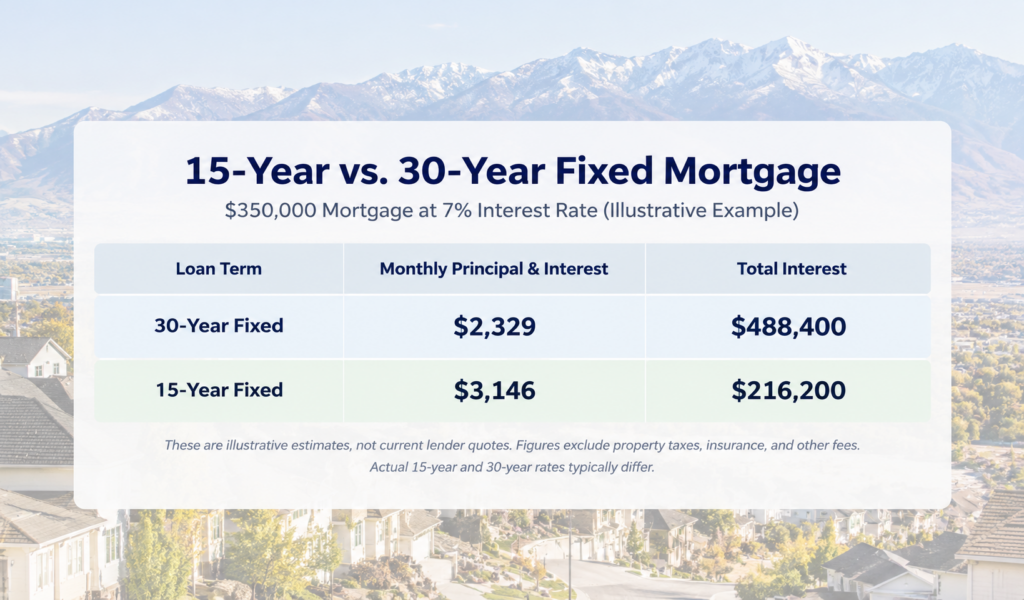
These figures are illustrative estimates, not current lender quotes. They exclude property taxes, insurance, and other fees. Actual interest rates may differ between loan terms.
In this example, choosing a 15-year mortgage means paying approximately $817 more each month, but saving around $272,200 in interest over the life of the loan.
While the 15-year option offers significant long-term savings, the lower monthly payments of a 30-year mortgage may provide more financial flexibility for everyday expenses, emergencies, and other savings goals.
Neither option is automatically better. The right choice depends on your income, budget, and long-term financial goals. If you’re considering a longer loan term, understanding 30-year fixed mortgage rates can help you explore your options and make a more informed decision.
How Does Your Credit Score Affect Your Mortgage?
After choosing a loan term, another important factor to consider is your credit score. This three-digit number helps lenders evaluate how likely you are to repay borrowed money and plays an important role in determining the mortgage interest rate you may qualify for. When comparing Utah mortgage rates, remember that your credit score can influence the interest rate lenders offer you.
Generally, borrowers with higher credit scores are more likely to qualify for competitive mortgage rates, while those with lower scores may face higher interest rates or fewer loan options.
For example, two Utah homebuyers applying for the same $300,000 mortgage could receive different interest rates based on their credit histories. Even a small difference in rates can add up to thousands of dollars in interest over the life of a loan.
The good news is that you can take steps to improve your credit score before applying for a mortgage. Paying bills on time, reducing credit card balances, and avoiding unnecessary new credit applications can help strengthen your financial profile.
For first-time Utah homebuyers, understanding your credit score early can help you prepare financially and potentially save money when it’s time to purchase a home.
What If You Have an 800 Credit Score?
Searching for home loan rates for 800 credit score can help borrowers understand the benefits of having excellent credit when purchasing a home.
An 800 credit score is generally considered excellent and may help you qualify for lower mortgage interest rates and more favorable loan terms. Even a small reduction in your interest rate could save you thousands of dollars over the life of your mortgage.
For example, imagine two Utah homebuyers who both have an 800 credit score and are applying for a $350,000 mortgage. One has minimal debt, while the other has significant monthly car payments and credit card obligations. Despite having identical credit scores, lenders may offer different loan terms based on their overall financial situations.
This is because lenders also consider factors such as your income, debt-to-income ratio (DTI), down payment, and loan type when evaluating your application.
For Utah homebuyers, maintaining excellent credit is a great advantage, but having a strong overall financial profile is just as important when shopping for competitive mortgage rates.
Can You Apply for a Mortgage With Bad Credit?
You might wonder if you can apply for a mortgage with bad credit.
The answer is that it may still be possible.
Some government-backed mortgage programs, such as FHA loans, have more flexible credit requirements than many conventional loans.
An FHA loan is a mortgage insured by the Federal Housing Administration. These loans can be helpful for buyers with limited savings or less-than-perfect credit.
However, lower credit scores may result in higher interest rates or additional borrowing costs.
If you’re not ready to purchase a home, improving your credit score and reducing debt could help you qualify for better terms in the future.

What Other Mortgage Options Are Available in Utah?
Not every Utah homebuyer has the same financial background, and a traditional mortgage isn’t the only option. Depending on your income, credit, location, and military service, you may qualify for specialized loan programs designed to lower upfront costs or make approval easier.
Some common examples include:
- FHA loans: Backed by the Federal Housing Administration, these are often popular with first-time buyers because they allow lower down payments and more flexible credit requirements.
- VA loans: Available to eligible veterans, active-duty service members, and surviving spouses.
- USDA loans: Designed for low- and moderate-income buyers in eligible rural areas.
- State programs: Utah Housing Corporation offers programs like the FirstHome loan for first-time buyers with modest incomes, along with down payment assistance for borrowers who qualify.
For example, a first-time buyer in Utah with a limited down payment might compare an FHA loan with a Utah Housing program to see which offers the better mix of monthly payment and upfront costs.
Eligibility rules, income limits, and available funds change, so it helps to review the details before you apply. The Consumer Financial Protection Bureau has a helpful overview of special loan programs that can help you compare your options.
Understanding VA Loan Qualifications
If you’re a veteran, active-duty service member, or eligible surviving spouse, researching VA loan qualifications could help you find additional financing opportunities.
A VA loan is a mortgage backed by the U.S. Department of Veterans Affairs. Eligible borrowers may benefit from no required down payment, no monthly private mortgage insurance, and competitive interest rates.
However, qualifying depends on your military service and other VA loan eligibility requirements. Lenders will also evaluate your finances and ability to repay the loan.
For eligible Utah homebuyers, comparing VA loans with conventional mortgages could help reduce upfront homebuying expenses.
Already Own a Home? Understanding HELOCs
So far, we’ve focused on buying a home. But what happens after you’ve owned your property for several years and built equity?
This is where a home equity line of credit, or HELOC, may be useful.
A HELOC, short for Home Equity Line of Credit, allows homeowners to borrow against some of the equity they’ve built in their property.
Home equity is the difference between your home’s current value and what you still owe on your mortgage.
For example, imagine your Utah home is worth $450,000 and you still owe $300,000.
That means you have approximately $150,000 in home equity.
However, lenders won’t necessarily allow you to borrow the entire amount. They also consider your income, credit history, and how much equity you must maintain.
How Do HELOC Rates and Payments Work?
When comparing heloc rates utah, you’ll notice many HELOCs have variable interest rates.
A variable interest rate means your rate can change over time, which may cause your monthly payment to increase or decrease.
Using a heloc payment calculator can help you estimate payments before borrowing.
For example, borrowing $20,000 at a hypothetical 9% annual interest rate would result in an interest-only payment of approximately $150 per month.
However, this payment doesn’t reduce your original loan balance. Once principal repayment begins, your required payment could increase.
While comparing lenders, you may come across searches for Figure HELOC reviews. Figure is one company offering home equity lending products, and reading customer reviews can help you better understand its application process, fees, and customer service.
Another important term to understand is the Figure HELOC draw period. A draw period is the timeframe during which borrowers can access funds from their home equity line of credit.
Traditional HELOCs typically allow homeowners to borrow money during a designated draw period before entering a repayment phase. However, lenders like Figure may structure their products differently, so it’s important to review their current terms, fees, and repayment requirements before applying.
For example, a Utah homeowner looking to fund a kitchen renovation might consider a HELOC to access their home’s equity. Comparing HELOC rates and home equity loans in Utah can help homeowners explore different lenders, understand borrowing options, and find financing that fits their budget.
Before making a decision, take time to compare interest rates, repayment terms, and any additional fees to ensure you’re choosing the right option for your financial goals.

How to Find the Right Mortgage Rate in Utah
Now that you understand the different mortgage options, how do you decide which one best fits your financial situation? Choosing the right home loan involves more than finding the lowest interest rate. It’s about balancing affordability, financial stability, and your long-term goals.
Before making a decision, consider these important questions:
How much can I comfortably afford each month? Your mortgage payment is only part of the cost of homeownership. Be sure to account for property taxes, homeowners insurance, utilities, maintenance, and everyday expenses.
How long do I plan to stay in my home? If you’re planning to settle down for many years, your priorities may differ from someone expecting to move in the near future. Consider how your plans affect your preferred loan term.
What does my credit score look like? A stronger credit profile may help you qualify for more competitive mortgage rates and better financing options.
Have I compared multiple lenders? Mortgage rates, closing costs, and loan requirements can vary between lenders. Taking time to compare mortgage loan estimates can help you identify differences in costs and terms before committing to a lender.
Do I understand APR? APR stands for Annual Percentage Rate. It reflects your interest rate along with certain borrowing costs, helping you compare the overall cost of similar mortgage offers.
Whether you’re buying in Salt Lake City, Provo, Ogden, or St. George, comparing Utah mortgage rates and understanding your financing options can help you choose a home loan that fits your budget and long-term goals.
Final Thoughts: Making Mortgage Rates Work for You
Understanding mortgage rates doesn’t have to be complicated.
Whether you’re comparing 15-year and 30-year mortgages, learning how credit scores affect borrowing, exploring VA loans, or considering a HELOC, the most important thing is understanding how each option fits your financial situation.
A lower interest rate can save you money, but the right mortgage also needs to fit your monthly budget and long-term goals.
Before making a decision, compare lenders, understand the terms, and consider how your mortgage will affect your finances over time.
For more information about Utah mortgage rates and home financing options, visit MortgageRateUtah.com to continue exploring resources for Utah homebuyers.