
Buying your first home is exciting, but figuring out how to pay for it can feel overwhelming. You may be asking what credit score you need, how much money to save, or whether you qualify for help with upfront costs. The good news is that first-time buyers have several mortgage options, and some Utah programs may help eligible buyers cover part of their down payment or closing costs.
This guide explains the key steps, from understanding lender requirements to comparing assistance programs, so you can make a more informed plan before you start house hunting.
Understand Mortgage Qualification Requirements Before You Shop
Before choosing a home, learn the mortgage qualification requirements that lenders use to evaluate an application. They commonly review your income, employment and income history, credit reports, monthly debt payments, savings, and the property you want to buy. Requirements vary by loan type and lender, so there is no single set of rules that applies to every borrower.
Your credit score needed for mortgage approval can affect both your eligibility and the interest rate you receive. The minimum credit score for mortgage approval depends on the loan program and the lender’s own standards. For example, FHA-insured loans may permit a score of 580 or higher for the 3.5% minimum down payment under FHA guidelines, although individual lenders may impose additional restrictions. Conventional, VA, and USDA loans have their own requirements.
Your first time home buyer credit score is only one part of the decision. Lenders also consider income stability, debt-to-income ratio, available cash, and credit history. Before applying, reviewyour credit reports for errors, pay bills on time, and avoid opening new credit accounts or taking on large new debts without discussing the potential impact with your lender.
How Much Down Payment Do I Need?
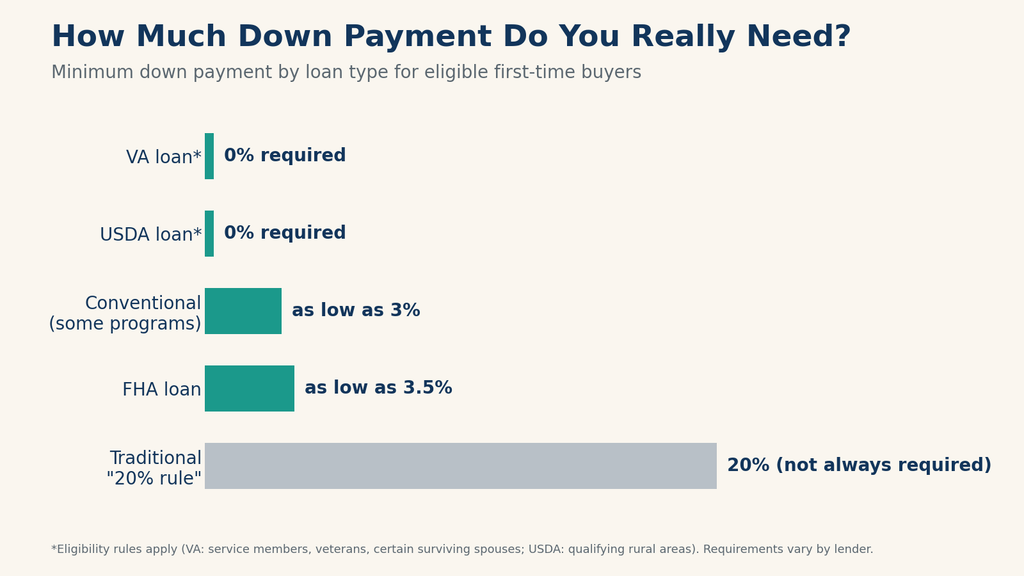
One of the most common questions is how much down payment do I need to buy a home? The answer depends on the loan program, your finances, and the property. Some conventional mortgages allow qualified borrowers to put down as little as 3%. FHA loans may allow a 3.5% down payment for eligible borrowers who meet the applicable credit requirements. Eligible VA and USDA borrowers may qualify for options with no required down payment.
That means the minimum down payment for a house is not always 20%. A larger down payment can reduce the amount you borrow and may lower some costs, but it is important not to drain all your savings just to put more money down. Keep funds available for moving, repairs, utilities, and emergencies.
Also plan for first time home buyer closing costs. These can include lender fees, appraisal and credit-report charges, title and settlement services, prepaid property taxes, and homeowners insurance. If you are wondering how much are closing costs, the Consumer Financial Protection Bureau explains that closing costs typically range from about 2% to 5% of the purchase price, although your actual amount will vary. Ask lenders for a Loan Estimate and compare costs instead of relying on a rough estimate alone.
Explore First Time Home Buyer Assistance in Utah
Upfront costs can be one of the biggest obstacles for a new buyer. Fortunately, first time home buyer assistance may be available through state housing programs, local governments, lenders, or nonprofit organizations. Assistance may come in the form of a grant, a deferred-payment loan, a forgivable loan, or another program structure. Each has its own rules, and not every program provides money that never needs to be repaid.
Research down payment assistance programs and first time home buyer down payment assistance options before deciding how much cash you need to save. Ask whether assistance must be repaid, whether you must live in the home for a certain period, and whether the program requires a specific first mortgage, homebuyer education, or a minimum personal contribution.
For local options, look into first time home buyer programs in Utah through the Utah Housing Corporation and your city or county. You can also search for first time home buyer programs near me, but confirm current availability, funding, and eligibility with the program administrator or a participating lender. Income limits, home-price limits, occupancy rules, and first-time-buyer definitions may apply. Be careful with the term first time home buyer grants. Some programs use “grant” to describe funds that do not need to be repaid if conditions are met; others provide a second mortgage or assistance that must be repaid later. Read the official program terms before counting the money toward your budget.
Compare Home Loans for First Time Buyers
There is no single mortgage designed for every first-time buyer. Comparing home loans for first time buyers can help you find a program that fits your credit, income, savings, and goals.
• Conventional loans: Some programs offer low down payments for qualified buyers. Mortgage insurance may apply when the down payment is below 20%, depending on the loan.
• FHA loans: These are insured by the Federal Housing Administration and can offer lower down-payment options for eligible borrowers. Mortgage insurance costs should be included in your comparison.
• VA loans: Eligible service members, veterans, and certain surviving spouses may qualify for VA-backed financing, often without a required down payment.
• USDA loans: Eligible buyers purchasing in qualifying rural areas may be able to use USDA-backed financing with no required down payment.
• State or local programs: Some can be paired with an eligible first mortgage to help cover upfront costs, subject to program rules.
When evaluating mortgage lenders for first time home buyers, compare more than the advertised interest rate. Review lender fees, annual percentage rate (APR), mortgage insurance, rate-lock terms, estimated monthly payment, and whether the lender participates in assistance programs. Request written Loan Estimates from several lenders when possible. Comparing offers can help you understand the full cost of borrowing.
How Much House Can I Afford?
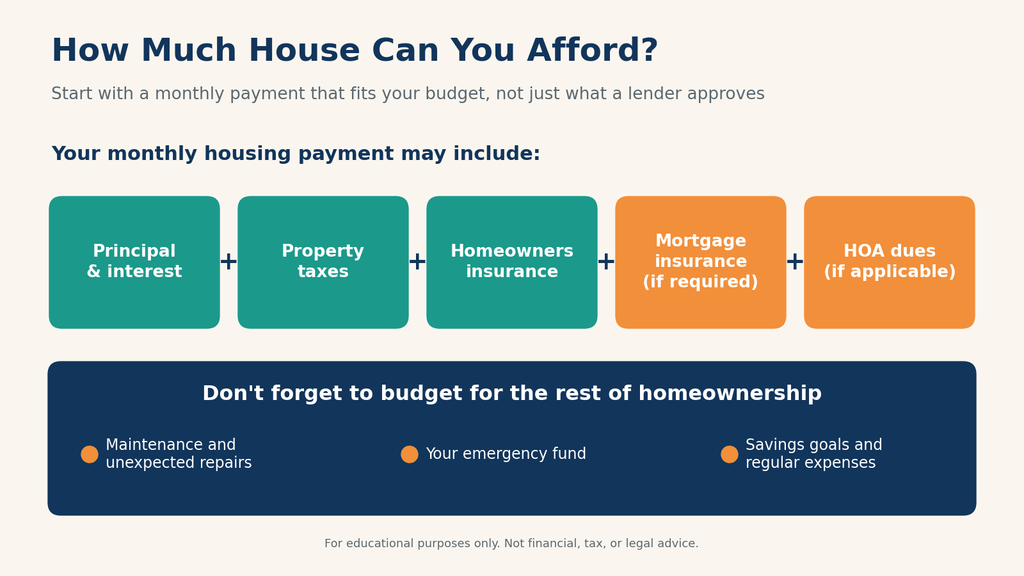
The amount a lender is willing to approve is not necessarily the amount you should spend. To decide how much house can I afford, begin with a monthly payment that fits your actual budget. Include principal and interest, property taxes, homeowners insurance, mortgage insurance if required, and homeowners association dues where applicable.
Review your regular expenses, debt payments, savings goals, and emergency fund. Remember that owning a home also means paying for maintenance and unexpected repairs. A mortgage calculator can help you explore scenarios, but use realistic estimates for taxes, insurance, and interest rates. Ask a lender to explain how different purchase prices and down payments change your total monthly payment.
Use a First Time Home Buyer Checklist
A practical first time home buyer checklist can keep the process organized:
1. Review your credit reports and correct any errors.
2. Calculate your monthly budget and estimate a comfortable home price.
3. Save for the down payment, closing costs, moving costs, and emergencies.
4. Gather pay stubs, tax documents, bank statements, and information about debts.
5. Compare mortgage programs and request preapproval from several lenders.
6. Ask about state, county, city, and lender assistance programs.7. Read your Loan Estimate carefully and compare it with other offers.
8. Before closing, review the Closing Disclosure and confirm the amount you need to bring to closing.
Your first time home buyer qualifications and first time home buyer requirements will depend on the mortgage and assistance programs you choose. Some programs define a first-time buyer as someone who has not owned a primary residence during a specified period; others use different rules. Do not assume you qualify based on the label alone. Ask the program administrator to confirm eligibility.
The first time home buyer benefits may include access to certain low-down-payment loans or assistance programs, but benefits are not automatic. Confirm the conditions, deadlines, and repayment rules before relying on them.
First Time Home Buyer Tips for a Confident Start
The most useful first time home buyer tips are to start planning early, ask questions, and compare the complete cost of each option. Do not focus only on the down payment or the lowest advertised rate. Consider the monthly payment, closing costs, mortgage insurance, and how much savings you will have left after moving in.
Get preapproved before making offers, but remember that preapproval is not a final guarantee of approval. Keep your finances stable while the loan is being processed, respond promptly to document requests, and never hesitate to ask your lender to explain a fee or condition in plain language.
Buying a home is a major financial decision, and the best path depends on your individual situation. By understanding your options, checking your eligibility for Utah assistance, and comparing lenders carefully, you can move toward homeownership with a clearer plan.
This article is for educational purposes only and is not financial, tax, or legal advice. Mortgage guidelines, rates, and assistance-program availability can change. Confirm current requirements with the lender or official program administrator before making a decision.