
Buying a home in Utah is an exciting milestone, but understanding your finances before applying for a mortgage is essential. One of the most important factors lenders consider is your debt-to-income ratio for mortgage approval. This ratio helps lenders determine how much of your monthly income is already committed to debt and whether you can reasonably manage a mortgage payment.
Whether you are a first-time homebuyer or looking to upgrade your current home, understanding your debt-to-income ratio (DTI) can help you make informed financial decisions. Your income, existing debt, down payment, and mortgage interest rate all influence how much home you can afford.
In this guide, we will explain how your debt-to-income ratio affects mortgage affordability, how to calculate your DTI, and how to estimate your homebuying budget in Utah.
How Does Your Income-to-Mortgage Ratio Affect Home Affordability?
Your income to mortgage ratio describes how much of your income goes toward your monthly housing payment. This is related to your debt-to-income ratio, which measures how much of your gross monthly income goes toward all required monthly debt payments.
When evaluating your mortgage debt-to-income ratio, lenders typically consider two measurements:
Front-end ratio: The percentage of your gross monthly income used for housing expenses, including principal, interest, property taxes, homeowners insurance, and applicable HOA dues.
Back-end ratio: The percentage of your gross monthly income used for housing expenses plus other recurring debts, such as student loans, car payments, and credit card minimum payments.
For example, imagine you earn $8,000 per month before taxes. Your proposed monthly housing payment is $2,400, and you have an additional $800 in monthly debt payments. Your front-end ratio would be 30%, while your back-end debt-to-income ratio would be 40%.
Understanding your debt-to-income ratio for home loan eligibility helps you see whether your budget aligns with mortgage lending guidelines.
What Is a Good Debt-to-Income Ratio?
Although requirements vary by lender and loan program, a DTI below 36% is often considered a conservative financial benchmark. Some mortgage programs allow qualified borrowers to have higher ratios, sometimes approaching 50%, depending on their financial qualifications and underwriting requirements.
Your debt-to-income ratio for mortgage approval is only one part of the lending decision. Credit history, employment stability, down payment savings, and other financial factors also influence your eligibility. Reducing existing debt can help improve your DTI and potentially increase your mortgage borrowing capacity.
How Much House Can You Afford Based on Your Income?
Determining how much home you can afford requires evaluating your income alongside your existing financial responsibilities. When calculating a mortgage based on income, lenders consider your gross monthly earnings, existing debt payments, available down payment, and the mortgage interest rate associated with your loan.
For example, two households earning $100,000 annually may qualify for different mortgage amounts if one has substantial student loans and car payments while the other has minimal existing debt. This is why a search such as “mortgage i can afford” cannot be answered using salary alone.
A common starting point for budgeting is the 28/36 guideline, which suggests spending no more than approximately 28% of gross monthly income on housing expenses and 36% on total debt payments. However, these percentages are budgeting guidelines, not universal mortgage approval requirements.
How to Calculate Your Debt-to-Income Ratio
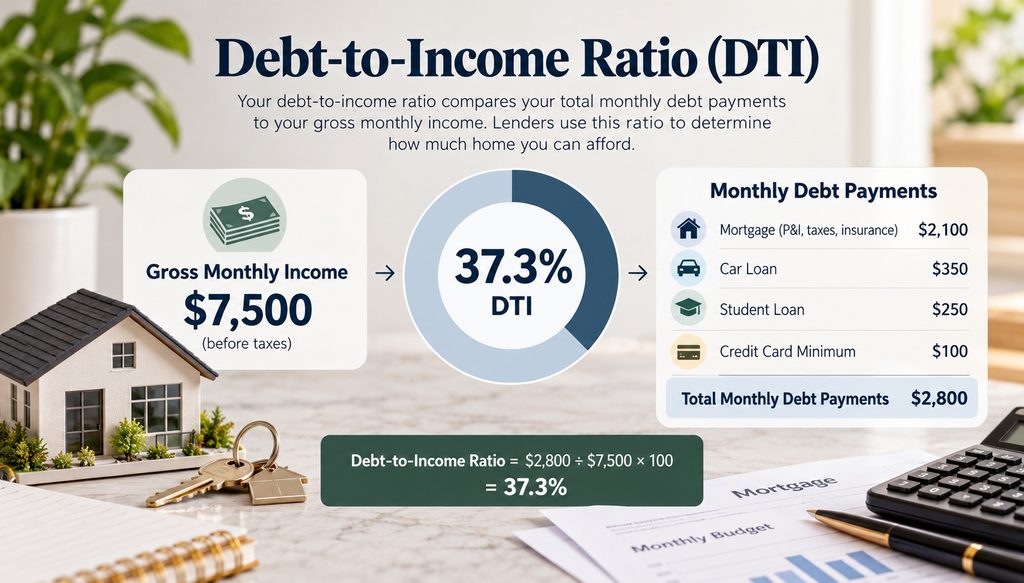
To calculate the debt-to-income ratio for mortgage qualification, add your required monthly debt payments and divide the total by your gross monthly income.
Debt-to-Income Ratio = (Total Monthly Debt Payments / Gross Monthly Income) x 100
For example, consider a Utah homebuyer with the following financial situation:
| Monthly financial information | Amount |
| Gross monthly income | $7,500 |
| Proposed housing payment | $2,100 |
| Car payment | $350 |
| Student loan payment | $250 |
| Credit card minimum payment | $100 |
| Total monthly debt payments | $2,800 |
$2,800 / $7,500 x 100 = 37.3% DTI. This means approximately 37.3% of the buyer’s gross monthly income would go toward required debt payments, including the proposed housing payment. Understanding your debt-to-income ratio for buying a house can help you determine whether reducing existing debt or adjusting your homebuying budget would be beneficial.
How to Use a Home Loan Affordability Calculator
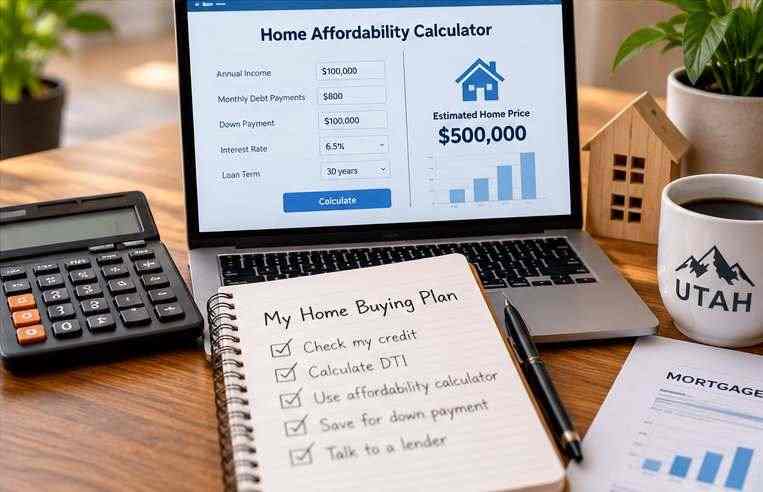
A home loan affordability calculator can help you estimate how much house you may be able to purchase based on your income, existing debts, down payment, and mortgage interest rate.
Many prospective buyers search for “mortgage calculator what can i afford” because they want to understand their purchasing power before contacting a lender. A reliable home mortgage affordability calculator should allow you to enter your financial information and estimate an affordable home price.
Most calculators consider gross annual or monthly income, existing monthly debt payments, down payment amount, mortgage interest rate, loan repayment term, and estimated property taxes and homeowners insurance.
A mortgage loan affordability calculator can also help you compare different scenarios. For example, increasing your down payment or reducing monthly debt payments may improve your estimated affordability.
Other common search terms include “housing loan affordability calculator” and “mortgage affordability calculator income.” These calculators generally help you understand the relationship between income, borrowing costs, and home prices.
For Utah homebuyers, affordability calculators are particularly useful when comparing properties in Salt Lake City, Provo, Ogden, and surrounding communities. However, remember that calculator results are estimates and do not guarantee mortgage approval.
How Much Income Do You Need to Afford a $500K House in Utah?
One common question among prospective homebuyers is how much income is necessary to purchase a $500,000 home. If you are searching for “income to afford 500k house,” the answer depends on your down payment, mortgage interest rate, existing debts, and other housing expenses.
Consider the following hypothetical scenario:
| Mortgage factor | Example |
| Home purchase price | $500,000 |
| Down payment (20%) | $100,000 |
| Mortgage loan amount | $400,000 |
| Loan term | 30 years |
| Interest rate | 6.5% |
| Monthly principal and interest | Approximately $2,528 |
| Estimated property taxes and insurance | $450 |
| Total estimated monthly housing payment | $2,978 |
The 6.5% interest rate is an illustrative assumption, not a current Utah mortgage rate quote. Actual property taxes and insurance costs also vary by home and location.
Using the conservative 28% housing-expense guideline, a buyer would need approximately $127,600 in annual gross income to support the estimated $2,978 monthly housing payment. However, this calculation assumes that the buyer’s other financial obligations do not create a more restrictive debt-to-income limitation.
For example, someone with significant student loans, car payments, or credit card debt may need a higher income to comfortably afford the same home.
Other Costs Utah Homebuyers Should Consider
When researching “price of house i can afford,” remember to include expenses beyond your monthly mortgage payment. These may include property taxes, homeowners insurance, utilities, maintenance, and HOA fees. A realistic budget should also account for emergency savings and other household expenses that may not be included in your lender’s DTI calculation.
How Can a Mortgage Debt-to-Income Ratio Calculator Help You?
A mortgage debt-to-income ratio calculator can help you understand how your existing financial obligations affect your ability to qualify for a home loan. Instead of manually calculating your DTI every time your income or expenses change, you can use an online calculator to evaluate different scenarios.
You may encounter tools described as a debt-to-income ratio mortgage calculator, debt-to-income mortgage calculator, or debt-to-income ratio to buy a house calculator. These tools generally allow you to enter your gross monthly income and required debt payments to estimate your DTI.
An income-to-mortgage ratio calculator may focus more specifically on how much of your earnings could go toward a monthly housing payment. For example, if you currently have a 45% DTI, paying off a car loan could lower your monthly debt obligations and potentially improve your mortgage eligibility.
Five Ways to Improve Your Mortgage Affordability
1. Reduce existing debt. Paying down loans or eliminating monthly debt obligations can improve your DTI and potentially increase your borrowing capacity.
2. Save for a larger down payment. A larger down payment reduces the amount you need to borrow and may lower your monthly mortgage payment.
3. Compare mortgage rates. Even a small difference in interest rates can affect your monthly payment and long-term borrowing costs.
4. Explore mortgage loan programs. Conventional, FHA, VA, and USDA loans have different qualification requirements and may offer options for borrowers with varying financial circumstances.
5. Create a realistic homeownership budget. Include property taxes, homeowners insurance, maintenance, and other expenses when evaluating affordability.
Frequently Asked Questions About Mortgage Affordability
How do I determine the house I can afford?
If you search for “house i can afford,” begin by reviewing your gross monthly income, existing debts, down payment savings, and estimated mortgage interest rate. An affordability calculator can help you determine a realistic purchase price based on your financial situation.
How much mortgage can I afford with my income?
If you search for “how much mortgage can i afford,” start by determining a comfortable monthly housing payment. Then use a mortgage affordability calculator to estimate the loan amount and home price that payment could support.
Does debt-to-income for mortgage qualification include credit cards?
Yes. When calculating debt-to-income for mortgage qualification, lenders generally include required monthly credit card minimum payments alongside other recurring debt obligations, such as car loans and student loans.
Can I qualify for a mortgage with a high debt-to-income ratio?
Possibly. Some mortgage programs allow higher DTI ratios depending on your credit profile, available savings, loan type, and other financial qualifications. However, a higher ratio may limit your financing options.
Is a 20% down payment required to buy a house in Utah?
No. Some mortgage programs allow qualified borrowers to purchase homes with less than 20% down. However, smaller down payments generally increase the loan amount and may require mortgage insurance.
Final Thoughts: Understanding Your Mortgage Affordability in Utah
Understanding your debt-to-income ratio is an important step toward making informed homebuying decisions. Whether you are purchasing your first home or considering a $500,000 property in Utah, knowing how your income and existing debts affect mortgage eligibility can help you plan confidently.
Before applying for a mortgage, review your financial obligations, calculate your DTI, compare mortgage rates, and explore available loan programs.
For additional Utah mortgage information, homebuying resources, and mortgage affordability guidance, visit MortgageRateUtah.com.
The more you understand your financial situation before buying, the better prepared you will be to choose a home that fits your budget and long-term goals.