
If you’re renting and asking how much house can I afford in Utah, you’re asking the right question
before you start touring homes. The answer isn’t just a price. It’s a monthly payment built from your
interest rate, loan type, down payment, mortgage insurance, property tax and insurance. This guide
walks through each piece with 2026 Utah numbers so you can set a budget that holds up when you sit
down with a lender.
What Is the Average Home Price in Utah?
The average home price in Utah sets the starting line. According to the University of Utah’s Kem C.
Gardner Policy Institute, the statewide median sale price across all home types reached $520,000 in
early 2026, and single-family homes sold for a median of $559,900 (Utah Business). Prices vary widely by
area. Salt Lake County’s single-family median hit $645,000 in mid-2026, while parts of Weber County
and southern Utah still have options under $500,000.
Mortgage Rates Utah Today and the 2026 Forecast
Your rate drives your buying power more than anything else. Mortgage rates Utah today track the
national market, and Freddie Mac’s weekly survey put the average Utah mortgage rates 30 year fixed
benchmark at 7.40% in mid-October 2026, up from 6.30% a year earlier (Freddie Mac). Lenders in Salt
Lake, Provo and St George Utah mortgage rates quotes can still differ by a quarter point or more, so
compare at least three. As for the mortgage rate forecast 2026, the National Association of Realtors’
chief economist expects rates to stay in the 7% range for now rather than drop sharply. See our latest
post on current mortgage rates in Utah for more context.
Use a Utah Mortgage Calculator With Taxes to Find Your True Payment
A listing price tells you little until you turn it into a monthly number. A Utah mortgage calculator with
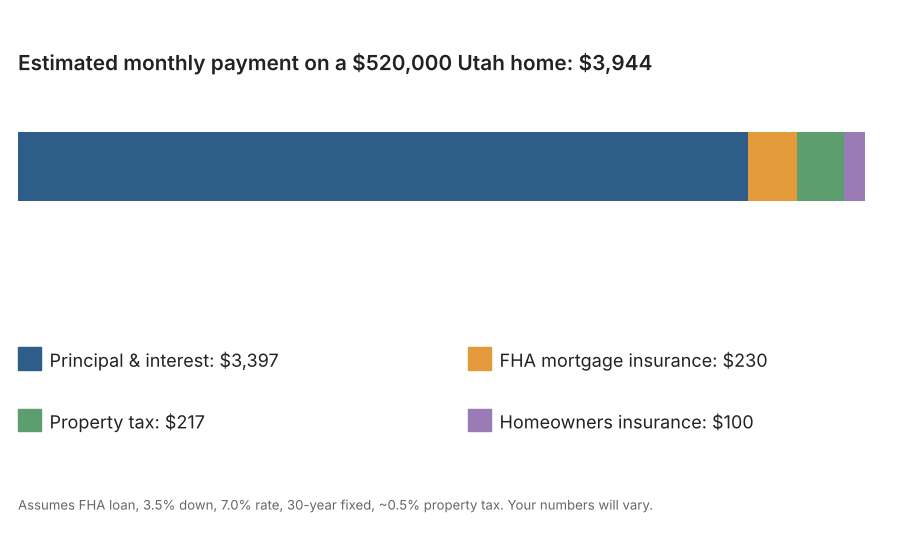
taxes adds the costs many online estimates leave out. On a $520,000 home with an FHA loan, 3.5%
down and a 7.0% rate, the payment comes to roughly $3,944 a month. About $3,397 is principal and
interest, $230 is FHA mortgage insurance, $217 is your Utah property tax mortgage payment, and
about $100 is homeowners insurance.
Most lenders want your housing payment near 31% of gross monthly income for FHA (28% is a common
conventional guideline). At $3,944 a month, that points to a household income of about $150,000. Your
total debts matter too, so read our guide to debt-to-income ratio for mortgage approval.
Credit Score Needed to Buy a House in Utah
The credit score needed to buy a house in Utah depends on the loan. FHA allows 580 with 3.5% down,
though many lenders set their own floor around 620 to 640. Conventional loans generally start at 620.
Utah Housing Corporation’s FirstHome loan asks for 660, and its Score Loan is the credit score loan Utah
Housing offers to buyers who have rebuilt their credit, starting at 620 (Utah Housing Corporation).
FHA vs Conventional Loan for First-Time Buyers
The FHA vs conventional loan first time buyer decision usually comes down to credit and down
payment. FHA is more forgiving on credit, but its mortgage insurance usually lasts for the life of the loan
when you put less than 10% down. Conventional loans need stronger credit, but PMI on first time home
buyer loan options can be canceled once you reach 20% equity. With a score above 700, conventional is
often cheaper over time.
Veterans should compare Utah VA loan lenders, since VA loans need no down payment and no monthly
mortgage insurance (our VA loan guide). Buyers outside the Wasatch Front should check USDA loan
eligibility Utah maps, because eligible rural homes can also be bought with zero down.
Utah FHA Loan Limits 2026 and Conforming Loan Limits
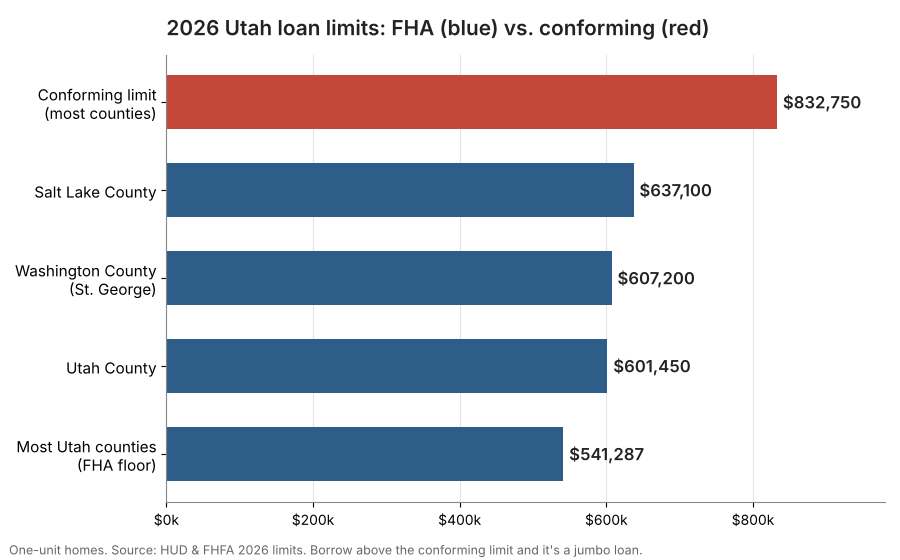
Loan limits cap how much you can borrow with each program. The Utah FHA loan limits 2026 start at
$541,287 for one-unit homes in most counties and rise to $601,450 in Utah County, $607,200 in
Washington County and $637,100 in Salt Lake County (HSH). The Utah conforming loan limits 2026 are
$832,750 in most counties, with higher limits in Summit and Wasatch counties (Rocket Mortgage).
Borrow above that and you’ll need a jumbo loan, where Utah jumbo loan rates and down payment rules
are usually stricter.
How Much Should I Put Down on a House?
If you’re wondering how much should I put down on a house, the minimum is 3% on many conventional
loans and 3.5% on FHA. Putting 20% down avoids PMI but takes years to save in most Utah markets. A
down payment assistance program Utah buyers can use is Utah Housing’s DPA second loan, worth up
to 6% of the first mortgage, which can cover the down payment and much of the closing costs.
If you’ve searched for a Utah first time home buyer tax credit, the state-funded help that actually exists
is the First-Time Homebuyer Assistance Program. It offers up to $20,000 as a zero-interest loan on a
newly built home priced at $450,000 or less, repaid when you sell or refinance (KSL). Read our full list of
first-time home buyer programs in Utah.
Utah Closing Costs for Buyers and Rate Buydowns
Budget for Utah closing costs for buyers of roughly 2% to 5% of the price, or $10,400 to $26,000 on a
$520,000 home. Lender fees, title insurance, prepaid taxes and insurance make up most of it. A Utah
mortgage rate buydown for first time buyers can also stretch your budget. In a 2-1 buydown, often paid
by the seller, your rate drops two points in year one and one point in year two before settling at the
note rate.
Choosing the Best Mortgage Lenders in Utah
The best mortgage lenders in Utah for you are the ones that offer the lowest total cost, not just the
lowest advertised rate. Compare Loan Estimates from national banks, local credit unions and other Utah
mortgage lenders. A mortgage broker Salt Lake City buyers hire can shop many wholesale lenders at
once, while a Utah County mortgage lender may know Provo and Lehi new-construction programs well.
Get pre-approved before you shop so sellers take your offer seriously.
Once you own, watch refinance rates Utah lenders publish and Utah HELOC rates too. If rates fall from
today’s highs, a refinance could lower your payment, and a HELOC lets you tap equity later. Our page on
current home loan refinance rates in Utah tracks both.
So, How Much House Can I Afford in Utah?
For most first-time buyers in 2026, a $520,000 home means a payment near $3,900 and an income near
$150,000. If your numbers are lower, the gap can be closed with assistance programs, a buydown or a
starter home under the FHA limit. Run your own figures through a calculator with taxes, check your
credit, and talk to two or three lenders this month.
Sources
- Freddie Mac Primary Mortgage Market Survey
- Kem C. Gardner Policy Institute report via Utah Business
- Salt Lake County median price, Utah News Dispatch
- NAR on September–October 2026 rates
- HSH 2026 FHA loan limits for Utah
- Rocket Mortgage 2026 Utah jumbo and conforming limits
- The Mortgage Reports: Utah Housing programs and credit scores
- KSL on Utah’s First-Time Homebuyer Assistance Program