

Remember when buying a home seemed like a natural next step after graduating college, starting a career, or getting married? For many young adults today, homeownership can feel much farther away. Understanding mortgage rate history can help first-time homebuyers see how housing costs have changed across generations and what those changes mean for buying a home today.
Rising home prices, down-payment requirements, and changing mortgage rates have made it important to understand not just the cost of buying a home, but how the housing market has evolved over time. Previous generations faced their own financial challenges, and today’s buyers face a different combination of obstacles.
The goal isn’t to compare your progress with your parents’ or grandparents’ timelines. Instead, learning from past housing markets, exploring financing options, and understanding your budget can help you make informed decisions about your future.
For Utah residents wondering whether homeownership is still possible, there are steps you can take to prepare. Understanding available loan options and exploring local assistance programs can help turn a seemingly distant goal into a realistic plan.
Mortgage Rate History: How Rates Have Changed Over the Decades
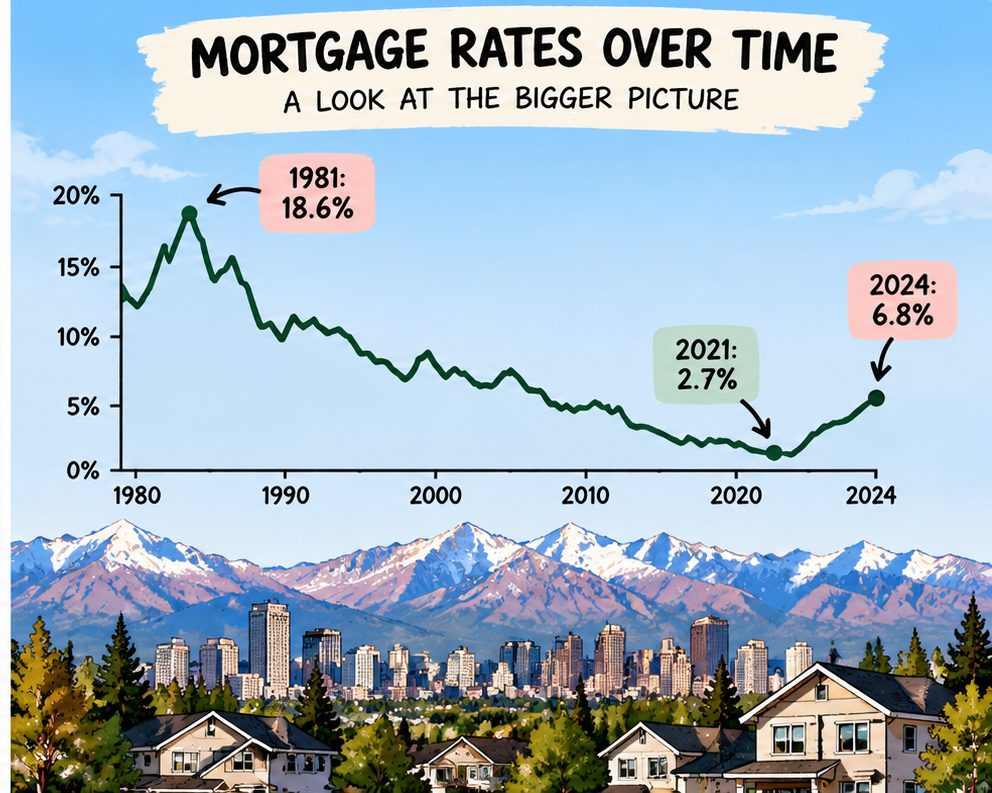
Mortgage rates have changed dramatically over the years. According to historical data from Freddie Mac, the average rate for a 30-year fixed-rate mortgage reached a weekly high of 18.63% in October 1981. Decades later, rates fell to a record weekly low of 2.65% in January 2021.
These figures demonstrate how much borrowing costs can vary from one period to another. Understanding mortgage rate history helps buyers compare different housing markets and recognize how interest rates influence the cost of financing a home. You can explore historical mortgage rate data directly through Freddie Mac’s Primary Mortgage Market Survey archive.
The 1980s: When Mortgage Rates Reached Historic Highs
In the early 1980s, buyers faced exceptionally high mortgage rates during a period of significant inflation. High interest rates made borrowing money expensive, even for buyers who could find a home within their budget. For example, a higher interest rate increases the amount of interest a borrower pays over the life of a mortgage, assuming other loan terms remain the same. This can significantly affect monthly payments and the total cost of homeownership.
This period is an important reminder that no generation has experienced exactly the same housing market. Someone purchasing a home in the 1980s faced a different set of financial pressures than someone buying in the 2000s or today. Looking at interest rates alone, however, does not tell the entire story. Home prices, wages, taxes, insurance, and household expenses also influence affordability.
The 2000s and 2010s: A Changing Housing Market
The housing market experienced major changes during the 2000s, including the housing crash and financial crisis. In the years that followed, mortgage rates generally trended lower, although homeownership remained out of reach for some households because of credit challenges, employment uncertainty, and other financial barriers.
During the 2010s, lower borrowing costs helped some buyers manage their monthly payments. However, a lower interest rate did not automatically make every home affordable. Buyers still needed sufficient income, savings, and a mortgage they could comfortably manage.
These decades show why it is important to consider the broader economic environment when evaluating homeownership. The cost of a home, the availability of credit, and a buyer’s financial circumstances all contribute to the decision to purchase.
2020–2021: Mortgage Rate History Lows
During the pandemic-era housing market, mortgage rates reached historic lows. Freddie Mac recorded a weekly average of 2.65% for a 30-year fixed-rate mortgage in January 2021. These low rates made borrowing less expensive for many qualified buyers. At the same time, strong housing demand and rising home prices created other affordability challenges in many markets.
This period illustrates an important lesson: the lowest mortgage rate does not necessarily mean the easiest time to buy a home. Buyers must consider the entire financial picture, including home prices, down payments, closing costs, and ongoing expenses.
How Mortgage Rates Have Changed Home Affordability
It is easy to look at a parent’s first home and wonder why purchasing a similar property feels so difficult today. Comparing homeownership across generations requires more than comparing the age at which someone bought a home. Home prices relative to household income, the amount of money needed upfront, student loan payments, property taxes, insurance, and other living expenses can all affect a buyer’s ability to qualify for a mortgage.
Mortgage rate history offers helpful context, but interest rates are only one part of housing affordability. A buyer securing a lower rate may still face high home prices, while someone purchasing a less expensive property at a higher rate may have a different overall financial outlook.
For today’s buyers, understanding the average down payment for a first-time homebuyer is another important step. The amount needed depends on the purchase price, mortgage type, lender requirements, and whether assistance is available. Some eligible loans allow lower down payments, but buyers should also plan for closing costs, inspections, moving expenses, and emergency savings.
Instead of asking, “Why haven’t I bought a home yet?” consider asking, “What would need to be true financially for buying a home to work for me?” That shift can turn discouragement into a practical plan.
First-Time Homebuyer Programs: Options for Utah Buyers
If you’re worried that you cannot afford a home, you do not have to figure everything out alone. Exploring first-time homebuyer programs is a useful place to begin.
Utah Housing Corporation offers mortgage and assistance programs through participating lenders. Depending on the program, a buyer’s circumstances, and current eligibility requirements, assistance may help with down payments or closing costs.Some programs have specific requirements relating to income, residency, purchase price, property type, or first-time buyer status.
Visit Utah Housing Corporation to review available programs and learn more about eligibility requirements. It’s worth reviewing the official guidelines and speaking with a participating lender before assuming you qualify. Program terms can change, and not every program is available for every home or borrower.
First-Time Homebuyer Loans: Compare Your Options
There is no single mortgage that works for every buyer. Comparing first-time homebuyer loans can help you understand how down payments, mortgage insurance, credit requirements, and monthly payments differ.
For example, FHA-insured mortgages may offer lower down-payment requirements for eligible borrowers. USDA loans may be an option for yers considering eligible rural properties, subject to program requirements. Some eligible buyers may also qualify for a zero-down-payment option through programs such as VA loans or qualifying USDA loans. These options are not available to everyone, and zero down does not mean zero closing costs.
When researching a first-time homebuyer loan, focus on the actual requirements and total cost rather than the name of the loan. The best mortgage is one that fits your financial situation, housing needs, and long-term plans.
Before choosing a loan, ask lenders about:
- Minimum down-payment requirements.
- Credit score and income requirements.
- Mortgage insurance and other recurring costs.
- Closing costs and lender fees.
- Available assistance programs.
- Estimated monthly payments and total borrowing costs.
Comparing these details can help you make a more informed decision.
How to Find the Right Lender and Interest Rate
When researching mortgage lenders for first-time buyers, compare more than advertised interest rates. Review lender fees, closing costs, mortgage insurance, customer support, loan options, and how clearly each lender explains the process.
Your first-time homebuyer interest rate will depend on factors such as market conditions, credit history, loan type, down payment, and lender pricing. Advertised mortgage rates can be useful for comparison, but a quoted rate is not guaranteed until the lender evaluates your circumstances and confirms the applicable terms.
Consider speaking with multiple lenders to compare estimates. Ask each lender to explain the annual percentage rate (APR), estimated monthly payment, cash needed at closing, and whether the quote includes discount points or other costs. The goal is not simply to find the lowest advertised number. It is to find financing you understand and can reasonably afford.
First-Time Homebuyer Mortgage Calculator: Plan Before You Buy
Before touring homes, take time to estimate what you can comfortably afford. A first-time homebuyer mortgage calculator can help you explore how the purchase price, down payment, interest rate, and loan term affect your estimated principal and interest payment.
For example, consider a hypothetical $350,000 home:
- With 3% down: The down payment would be $10,500.
- With 5% down: The down payment would be $17,500.
- With 10% down: The down payment would be $35,000.
These examples show how the amount you put down changes the starting loan balance. They do not include closing costs or other expenses, and the lowest down-payment option may involve mortgage insurance or other costs.
A first-time homebuyer down-payment calculator can help you estimate how much you may need to save. A home loan calculator can help you compare different financing scenarios, while a mortgage calculator can provide a broader estimate of monthly payments. Remember that property taxes, homeowners insurance, mortgage insurance, and homeowners association fees may increase your total monthly housing cost.
Related resource: First-Time Home Buyer Mortgage Calculator
How to Qualify for a Home Loan as a First-Time Buyer
Learning how to qualify for a home loan can make the process less intimidating. Lenders typically review income, employment, credit history, existing debts, assets, and details about the proposed property. If you want to prequalify for a mortgage, ask a lender what information they need to provide an initial estimate. Prequalification is not the same as final loan approval, and the process can vary by lender.
A first-time homebuyer preapproval can provide a more detailed estimate of what you may be able to borrow after the lender reviews your finances. Even then, approval and final loan terms depend on further verification and the property.
If you’re researching how to get a mortgage as a first-time buyer, begin by reviewing your credit, calculating your recurring expenses, and estimating how much you can save each month. Then compare lenders and ask questions before committing to a loan.
When you’re ready to apply for a first-time home loan, gather documents such as recent pay stubs, tax documents if requested, bank statements, and information about your debts and assets. Your lender can explain the application process, next steps, and any additional documentation needed.
What Mortgage Rate History Can Teach Us: Keep Planning, Not Comparing
Mortgage rate history offers valuable perspective, but past rates cannot predict exactly what rates will be in the future. Rates have climbed to historic highs, fallen to historic lows, and moved through many periods in between. No one can reliably promise when the next major shift will happen, so waiting for a perfect market is not a guaranteed strategy.
By studying past mortgage rates alongside home prices and income, first-time buyers can better understand why affordability differs across generations. However, historical trends should be used as context rather than as a guarantee of future market conditions.
Instead, focus on what you can control: understanding your finances, building savings, learning about available programs, and avoiding a payment that stretches your budget too far. If today’s first-time homebuyer mortgage options seem overwhelming, start with one small step, such as calculating a realistic monthly payment or speaking with a housing counselor or lender. If you’re comparing mortgage rates, remember that your personal quote may differ from national averages and advertised offers.
The right time to buy depends on your financial readiness, housing needs, and plans—not simply your age or what someone else did. A mortgage should support your life rather than leave you financially stressed. You do not need to follow the same timeline as your parents, friends, or coworkers to make progress toward homeownership.

Your First Home May Still Be Possible
Buying a home may look different for today’s generation, but history is a reminder that market conditions are not fixed. While mortgage rates and home prices can create real challenges, education and careful planning can help you understand your options.
Start by reviewing your budget, exploring eligible Utah homebuyer programs, and comparing financing options with qualified lenders. If you’re not ready to buy today, saving and preparing now can still move you closer to your goal. You don’t have to solve the entire process at once. Learn what is available, ask questions, and take the next step when it makes financial sense for you.
Explore more: Utah First-Time Homebuyer Programs, Grants, and Loans
You can also visit the Consumer Financial Protection Bureau’s Owning a Home resource for additional information about preparing for a mortgage and navigating the homebuying process.
Disclaimer: This article is for educational purposes only and is not financial, tax, or legal advice. Mortgage rates, loan requirements, and assistance program availability change. Verify current terms and eligibility with official program administrators and qualified lending professionals before making a decision.