

VA Home Loans Made Easy: Your Guide to Buying in Utah

For many veterans, active-duty service members, and eligible surviving spouses, the dream of homeownership is more attainable than ever, all thanks to the VA home loan program. Backed by the U.S. Department of Veterans Affairs, a VA home loan is a powerful mortgage option that offers significant benefits, including no down payment, competitive interest rates, and limited closing costs.

If you’re exploring the idea of buying a home in Utah, a VA home loan could make the journey much smoother and more affordable. Whether you’re just starting to look or already have your dream home in mind, considering your financing options is a smart first step. From getting pre-approved to working with trusted local lenders, this guide breaks down everything you’ll need to know in order to make buying your home as easy as can be!

How to Get Pre-Approved for a VA Home Loan

The first step in your journey is learning exactly how to get pre-approved for a VA
home loan. This is where a lender checks your income, credit, and eligibility to give you an
idea of how much you can borrow.

To get pre-approved for a VA home loan, you’ll typically need:

  • Certificate of Eligibility (COE): This verifies your VA loan entitlement and eligibility.
  • Proof of income: Recent pay stubs, W-2s (or tax returns if self-employed), and possibly verification of other income sources like disability or retirement.
  • Employment history: Usually a two-year work history is requested.
  • Credit report: Lenders will review your credit history and score to assess risk.
  • Details on assets and debts: Bank statements, investment accounts, and information on monthly obligations like car payments or student loans.
  • Government-issued ID: Such as a driver’s license or military ID for identity verification.

While these documents are only required for pre-approval, having them ready early can give you an edge. Utah’s housing market moves quickly, so being prepared to act when the right home comes along can make all the difference.

VA Home Loan Application Process: What You’ll Need
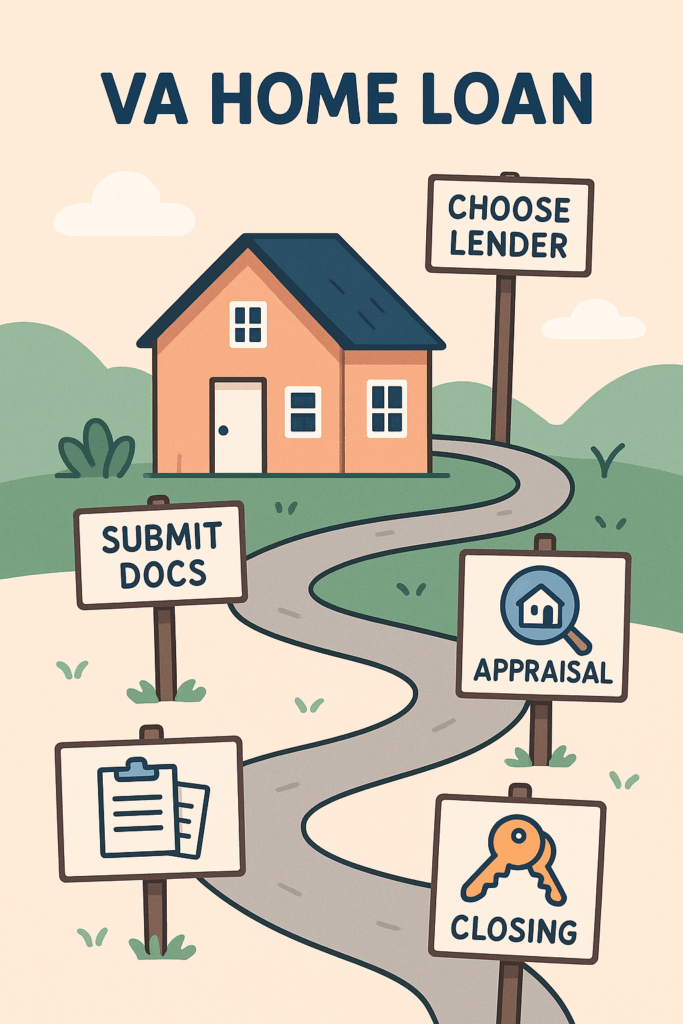
Cartoon-style illustration showing a winding path to a home with labeled signs representing steps in the VA loan application process: Choose Lender, Submit Docs, Appraisal, and Closing.

Once you’re pre-approved, the next step is completing your VA home loan application. The process is straightforward when you’re working with an experienced VA-approved lender and have your documents in order.

Here’s what the application process typically involves:

  • Choose a VA-approved lender in Utah
    • Pick a trusted, experienced lender who handles VA loans regularly.
  • Complete the full loan application
    • Fill out the Uniform Residential Loan Application (Form 1003) with your lender’s help.
    • Collect and submit the commonly required documents:
      • DD-214 or Statement of Service
      • Certificate of Eligibility (COE)
      • Pay stubs, W-2s, tax returns
      • Bank statements
      • Photo ID
  • VA appraisal ordered by lender
    • Confirms the home’s value and that it meets VA property standards.
    • Note: This is not a full home inspection—consider getting one separately.
  • Underwriting review
    • The lender reviews your finances and the appraisal.
    • They may request additional documents during this step.
  • Clear to close
    • Once everything is approved, your lender will schedule the closing.

Many local Utah VA loan programs also offer extra support, such as assistance with closing costs or streamlined processing, to help make the path to homeownership even smoother.

VA Loan Requirements, Tips, and Tools

Unlike most private loans, VA loans don’t require perfect credit, making homeownership more accessible for veterans and service members. With more flexible credit guidelines than conventional mortgages, VA loans are designed to work in your favor. While the Department of Veterans Affairs doesn’t set a strict minimum credit score, most Utah lenders look for a score of around 620. If you happen to have a lower score, DON’T WORRY! A strong income, low debt, and a steady employment history can still help you qualify. Additionally, lenders also consider your residual income and VA eligibility when determining how much home you can afford.

Before you commit to a home, it’s smart to explore your financing options using online tools. Using a VA Home Loan Calculator can help you estimate your monthly mortgage payments based on loan amount, interest rate, and term. Check out the link below for this tool:

These calculators can give you a clearer idea of what fits your budget and help you compare potential homes. Just remember, online estimates are a great start, but always check with your lender for the most accurate numbers based on current VA loan rates in Utah.

Securing your Personal Rates and Payments
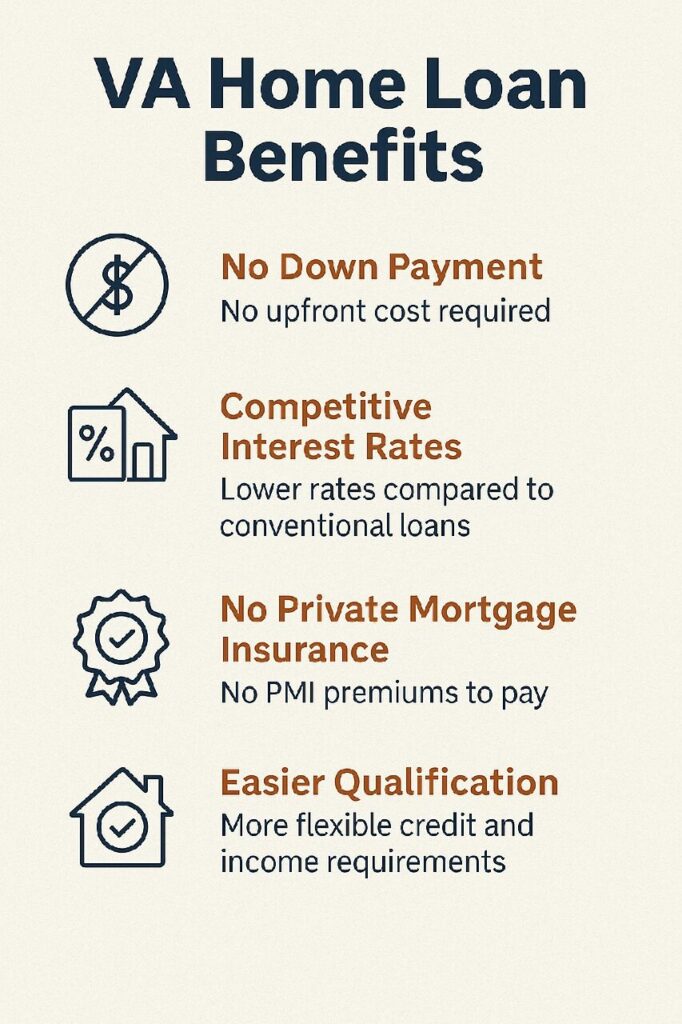
List detailing the benefits of a VA Home Loan

One of the biggest perks of a VA home loan is getting a lower interest rate. If you’ve been searching for “VA mortgage rates today” or “VA loan rates in Utah,” you’ll notice they’re often better than regular mortgage rates. That means you could save thousands over time.

Here are a few simple tips to help you get the best deal:

  • Lock in your rate early so it doesn’t go up later
  • Ask your lender if a fixed or adjustable rate is better for you
  • Check VA loan rates in Utah often—they can change daily
  • Try using a VA loan calculator to estimate your monthly payment

If you’re buying your first home, the benefits only increase with a VA loan:

  • No down payment
  • No private mortgage insurance (PMI)
  • Lower interest rates
  • Fewer upfront costs

Interested in stacking benefits? Check out another one of our articles that dives deeper into additional programs backed by local Utah governments and regional lenders;

Not ready to apply just yet? You can still get prequalified for a VA loan with no commitment. It’s a quick way to see what you might qualify for before you start shopping for a home.

Final Thoughts and Next Steps

Buying a home is a big step, but with a VA home loan, it doesn’t have to be overwhelming. Whether you’re a first-time buyer or just new to the VA loan process in Utah, the right tools and support can make all the difference. From getting pre-approved to locking in a great rate, you have access to benefits designed to make homeownership easier and more affordable. Take your time, ask questions, and lean on trusted lenders to guide you. You’ve earned this, and your path to a new home might be closer than you think.

Ready to get started? Check out the link below to be paired with a trusted VA loan lender in Utah and begin your pre-approval process today.

https://www.bestmoney.com/mortgage-loans/compare-va-loans

Free Mortgage Estimator: Plan Your Home Loan With Confidence

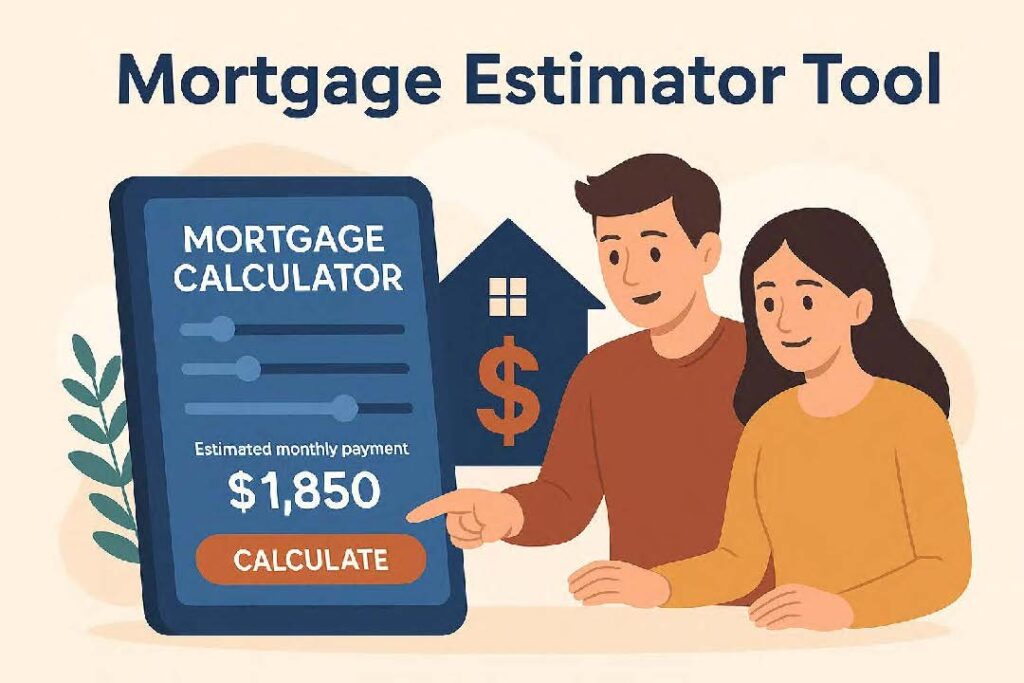
Mortgage Estimator Tool

Buying a home is one of the most important financial steps you’ll ever take, and the first thing you need is information. With the right tools—like a mortgage calculator free, mortgage estimator based on income, or mortgage estimator tool—you can confidently plan your next move in Utah’s competitive housing market. Whether you’re a first-time buyer, investor, or planning to refinance with bad credit, we’ve gathered everything you need to make smarter decisions. Use our free mortgage estimator to be up to date on Utah Home Loan tools and advice.

Mortgage Estimator Tools Every Buyer Should Use

Before you reach out to a lender, use a free mortgage estimator tool to estimate your monthly payments. Most calculators allow you to input your down payment, loan term, and interest rate. More advanced platforms like the mortgage estimator Zillow or a mortgage estimator based on income offer deeper insights based on your salary and debt ratio.

Want to go deeper? Try a how much mortgage can I afford calculator to know your exact buying power before you apply online.

Mortgage Estimator Free | Utah Home Loan Tools and Advice

First-Time Buyers: Mortgage Tips for Utah Residents

Shopping for a mortgage for first time buyers in Utah? You’re in luck. There are dozens of home loan assistance [state] programs that offer grants, lower down payments, or reduced closing costs. To find the best mortgage for new home buyers, look for fixed-rate terms, low fees, and flexible credit requirements.

Don’t forget to learn how to qualify for a mortgage first time buyer. Most programs require proof of income, job stability, and sometimes a credit score over 620.

Refinancing Your Home, Even with Bad Credit

Many Utah homeowners benefit from a refinance, whether to lower monthly payments or change loan terms. Start by comparing mortgage refinance rates and learning how to refinance my mortgage based on your goals. Even with poor credit, refinance with bad credit options exist.

The key is working with the best lenders for refinancing, especially local mortgage lender near me options or a mortgage broker in [city] who understands Utah’s market.

Understanding Home Equity Loan vs HELOC

Many Utah homeowners tap into their home’s value to cover renovations or major expenses. The most common options are a home equity loan vs heloc. A home equity loan with good credit is ideal for those who want fixed monthly payments. If you’re less creditworthy, a home equity loan with bad credit may still be possible, but rates will be higher.

Need more flexibility? A home equity loan vs line of credit comparison will help you understand whether you want a lump sum (loan) or revolving credit (HELOC).

Mortgage Estimator Free | Utah Home Loan Tools and Advice

Investment Properties and DSCR Loans

Looking beyond your primary residence? You’ll want to consider a mortgage for second home or a loan for real estate investment. If you’re investing in rental property, a dscr loan for investors may be the best option—it’s based on rental income, not your personal debt-to-income ratio.

Application Tips and Staying Informed

Apply anytime with a mortgage application online and speed up the process. Use a mortgage pre approval tool to strengthen your offer and avoid surprises during underwriting. Staying informed through mortgage news and regularly checking the best mortgage rates in [city] can save you thousands over the life of your loan.

Need help choosing the right partner? Ask local home loan providers for quotes or schedule time with a mortgage broker in [city].

Conclusion

Whether you’re applying for a mortgage for first time buyers, considering a home equity loan vs heloc, or looking for home loan assistance [state], you don’t have to do it alone. Use every tool at your disposal—from a mortgage estimator free to a mortgage application online—and compare options wisely.

Don’t forget: your financial future begins with knowledge. Bookmark this page, check back for mortgage news, and reach out to local home loan providers to get started today.

Navigating 30-Year Fixed-Rate Refinancing in Utah: Your Complete Guide

Person deciding to refinance

Navigating 30-Year Fixed-Rate Refinancing in Utah: Your Complete Guide

For many Utah homeowners, their home is not just a place to live; it’s a significant financial asset. As market conditions evolve, understanding your mortgage options becomes paramount. Among the various choices, the 30-year fixed-rate mortgage stands out as a popular and stable option, especially when considering refinancing. This guide will delve into the intricacies of 30-year fixed-rate refinancing in Utah, exploring everything from current refinance rates 30 year fixed to the potential impact on your monthly budget and long-term financial goals. Haven’t bought your forever home yet? Check out our tips and tricks to buying in Utah.

Understanding the Appeal of a 30-Year Fixed Mortgage

A 30-year fixed mortgage offers remarkable predictability, a quality highly valued by homeowners. Unlike adjustable-rate options, this loan type is characterized by a consistent interest rate throughout the entire loan term. This stability ensures that the principal and interest portion of your mortgage payment 30 years remains unchanged, providing a predictable housing cost for three decades. When you decide to refinance into a 30-year fixed loan, you are essentially replacing your existing mortgage with a new one that locks in these stable rates refinance 30 year fixed, offering a sense of financial security. Want to learn more about your current mortgage? Check out our helpful piece on understanding your mortgage .

Why Consider Refinancing Your Mortgage?

The decision to refinance into a new 30 year mortgage is often driven by several strategic financial motivations. Understanding these can help you determine if it’s the right move for your current situation:

  1. Lowering Your Monthly Payments: This is perhaps the most compelling reason homeowners explore refinance rates 30 year fixed. If today’s refinance mortgage rates 30 year fixed are significantly lower than what you’re currently paying, even a modest reduction can lead to substantial long-term savings and a more manageable mortgage payment 30 years. Many individuals actively seek the lowest 30 year refinance rates or the best 30 year refinance rates to optimize their monthly budget.
  2. Accessing Home Equity (Cash-Out Refinance): A cash out refinance rates 30 year fixed allows you to leverage your home’s accumulated equity. This popular option provides a lump sum of cash, ideal for funding major expenses such as home renovations, educational pursuits, or consolidating high-interest debt. When considering this, it’s crucial to thoroughly evaluate the 30 year cash out refinance rates and compare them against other financing avenues.
  3. Changing Loan Terms: Life circumstances change, and so might your financial capacity. If you’re currently managing a more aggressive 15-year loan and find its higher mortgage payment challenging, refinancing from 15 to 30 year loan can dramatically reduce your monthly obligations, thereby improving your cash flow. Conversely, if your goal is to pay off your home faster and you can comfortably afford higher payments, refinancing from 30 year to 15 year mortgage can save you significant interest over the loan’s lifetime.
  4. Switching Loan Types: For those with an adjustable-rate mortgage (ARM) who desire greater stability, a 30-year conventional mortgage refinance rates option provides the security of a predictable fixed rate, shielding you from future market fluctuations.

Factors Influencing Your 30-Year Refinance Rate

While general trends like the average 30 year refinance rate are widely reported, your specific refinance rates 30 year fixed in Utah will be a personalized reflection of several individual and broader market factors:

  • Credit Score: Your creditworthiness is a primary determinant. A robust credit profile, typically a FICO score of 740 or higher, will generally qualify you for the most favorable and lowest 30 year mortgage refinance rates.
  • Loan-to-Value (LTV) Ratio: This ratio compares your loan amount to your home’s appraised value. A lower LTV, indicating substantial equity in your home, usually translates into more competitive rates refinance 30 year fixed.
  • Debt-to-Income (DTI) Ratio: Lenders meticulously assess your ability to comfortably manage monthly payments by comparing your total monthly debt obligations against your gross monthly income.
  • Discount Points: You may have the option to pay “points” (prepaid interest) at closing, which are essentially prepaid interest. In exchange for this upfront cost, you can secure a lower interest rate over the life of the loan.
  • Market Conditions: Broader economic indicators, including inflation rates and the monetary policies set by the Federal Reserve, exert a direct influence on mortgage rates today refinance 30 year fixed across the market.

Understanding Your 30-Year Mortgage Payments: A Look at the Numbers

Understanding 30-Year Mortgage Payments

One of the most practical considerations for any homeowner contemplating a refinance is the actual mortgage payment 30 years. While an online mortgage 30 years calculator is an invaluable tool for precise figures, let’s explore some typical scenarios to give you an idea of potential monthly principal and interest payments (note: these figures are illustrative and do not include property taxes or home insurance, which vary by location in Utah):

  • For a $100 000 mortgage payment 30 years, at an example 6.5% interest rate, your principal and interest payment would be approximately $632.
  • A $250 000 mortgage payment 30 years at the same 6.5% rate would be around $1,580.
  • If you have a $300 000 mortgage payment 30 years, expect to pay roughly $1,896.
  • For a $350 000 mortgage payment 30 years, the payment could be approximately $2,219.
  • And for a $400 000 mortgage payment 30 years, it would be in the vicinity of $2,528.
  • Even for a $500 000 mortgage 30 years, the monthly principal and interest could be around $3,160.

These examples powerfully demonstrate how significantly the total loan amount impacts your monthly mortgage payment 30 years, even with consistent interest rates.

The Pros and Cons of a 30-Year Fixed Refinance

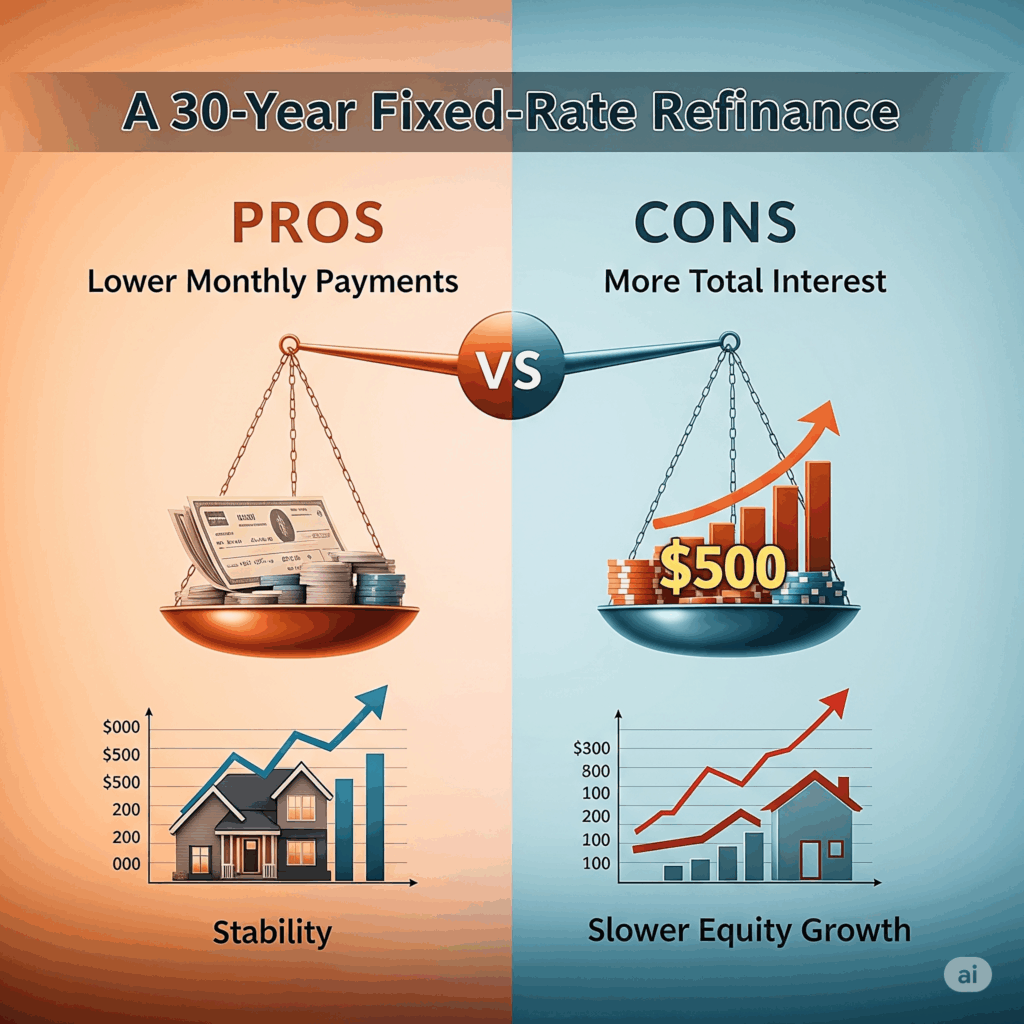
Pros and Cons of 30-Year Fixed Refinance

Choosing a 30-year fixed loan for your refinancing comes with a distinct set of advantages and disadvantages, which are crucial to weigh against your personal financial goals:

Pros:

  • Lower Monthly Payments: Spreading the loan over 30 years typically results in the lowest possible monthly principal and interest payment, significantly improving your monthly cash flow.
  • Payment Stability: The fixed interest rate provides unparalleled budget predictability, effectively shielding you from future rate hikes and market volatility.
  • Financial Flexibility: Lower payments can free up valuable funds that can be strategically redirected towards other investments, bolster your savings, or accelerate the repayment of other higher-interest debts.
  • Wider Lender Choice: Due to its widespread popularity, you’ll generally find a broad array of competitive 30 year mortgage quote options from numerous lenders, offering ample choice.

Cons:

  • More Total Interest Paid: Over a lengthy 30-year term, you will inevitably pay a significantly larger sum in total interest compared to a shorter-term loan, such as a 15-year fixed mortgage.
  • Slower Equity Build-Up: The extended amortization schedule means that a smaller proportion of your early payments is allocated towards reducing the principal, which can slow down the pace at which you build home equity.
  • Slightly Higher Interest Rates: In some market conditions, the 30 year refinance rates offered might be marginally higher than the interest rates available for 15-year terms on the same day.

Specialized 30-Year Refinance Scenarios and Lender Considerations

Beyond the standard conventional mortgage refinance rates, several specialized scenarios might apply when considering a 30-year fixed loan:

  • 30 year second home mortgage rates: If you own a vacation home or an investment property in Utah, refinancing it can carry different rate implications compared to a primary residence, often due to perceived higher risk.
  • Lender-Specific Rates: As you explore the lowest 30 year mortgage rates refinance, you’ll likely encounter specific offers from various financial institutions. For instance, some individuals actively seek USAA 30 year mortgage rates, Navy Federal 30 year mortgage rates, or Alliant Credit Union 30 year mortgage rates. It’s always prudent to compare offers from a diverse range of lenders to ensure you secure the best 30 year refinance rates tailored to your unique financial situation.

Getting Your Personalized 30-Year Mortgage Quote in Utah

The most effective way to determine if a 30-year fixed-rate refinance aligns with your financial aspirations is to obtain a personalized 30 year mortgage quote. It’s important not to rely solely on broadly advertised mortgage rates today refinance 30 year fixed, as these are often presented for ideal borrower profiles. A local Utah mortgage professional possesses the expertise to help you understand all the intricate factors at play, including closing costs and fees, and can expertly guide you through every step of the process. They can thoroughly explain how various scenarios, such as refinancing from 15 year to 30 year or vice-versa, will specifically impact your financial future.

Ultimately, whether your primary goal is to find the lowest 30 year refinance rates to significantly reduce your monthly expenses, or you’re contemplating a cash out refinance rates 30 year fixed to strategically unlock your home’s equity, making a well-informed decision is paramount. By understanding the profound nuances of the 30-year fixed loan, diligently comparing rates refinance 30 year fixed, and carefully considering your long-term financial objectives, you can confidently navigate the dynamic Utah mortgage market. We encourage you to reach out to a local expert today to get a tailored 30 year mortgage quote and thoroughly explore all your available options.